An impatient world
“It is not that we have a short time to live, but that we waste much of it… life is long if you know how to use it.”
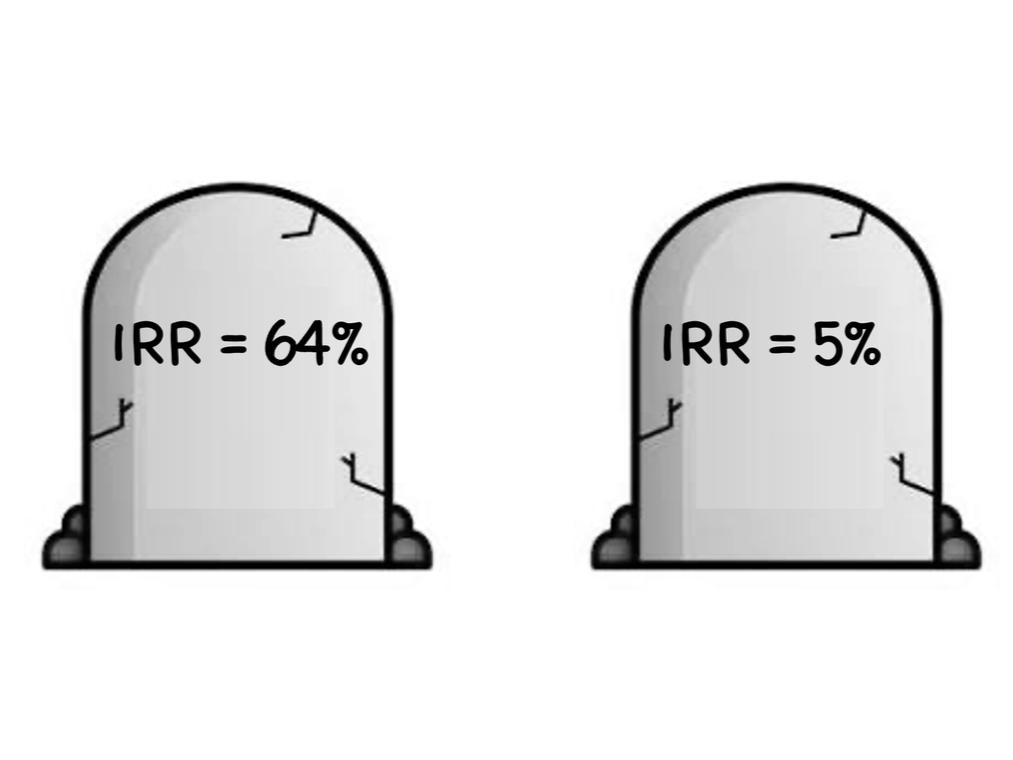
“How will you measure your life?”
- - -
I borrow the phrase “How Will You Measure Your Life?” from the Harvard Business School professor, Clayton Christensen, who posed this question to his students as written in a 2010 article.
Christensen urged corporate executives to think beyond the conventional yardsticks of success and consider what truly makes a life meaningful. He has passed since, leaving behind a distinguished academic and professional legacy—one that many would regard as the pinnacle of a lifelong achievement.
The picture of the tombstones above—though not taken from Christensen’s article—is a sobering reminder that our lives, both in the biological and professional sense, are finite.
No matter how accomplished we are, the endgame is ultimately the same. What remains after we are gone are the inscriptions: a snapshot or a brief summary of how a life might be remembered.
The IRRs (internal rate of return) on these inscriptions reflect what we believe success should look like—or at least the version of success we think we want the world to see. Wealth, titles, and decorated accomplishments convey to others “here is a life well-lived”, vis-à-vis those around us, living or dead.
- - -
Humans are imitative by nature and hence, we believe that our successes are meaningful only if we compare them with others. To specifically quote French academic, René Girard:
“Man is the creature who does not know what to desire, and he turns to others in order to make up his mind.”
Just as capital flows to the project with the highest IRR, the epitome of success amongst white-collared executives often goes to the one with the highest net worth. Those who measure their lives based on this tend to view success along two narrow dimensions: results and speed.
It’s not enough to win, one has to win quickly. Expansion must be fast. Scale must be immediate. If you are not the first, you are last.
Over the past few decades, for good or bad, technological progress has intensified this mindset. What began as a push for productivity gradually evolved into a culture obsessed with acceleration.
But there is a fundamental problem with this.
Not everything we build—markets, companies, technologies—can be maximized for speed and efficiency. Some of the most important processes in life require repetition, patience, and a gradual accumulation of experience.
I completely understand the need to be ambitious, but at what cost?
- - -
Before email, the world operated on roughly 50% capacity since most people could only be reached via phone on weekdays during working hours to get stuff done. With the introduction of email and the Blackberry, communication outside the office and outside office hours are made even easier, successfully increasing this capacity.
Today, instant messaging apps are pushing these limits even further. Mobile apps have completely re-written the rules and boundaries of work and personal life, making it almost imperative for anyone to respond almost immediately to a Whatsapp or Wechat message as soon as it comes in.
As a result, we now live in a highly impatient world, and it is not slowing down. Even at the current moment, people around the world are building robots and training AI agents that can execute tasks much faster and sometimes more effectively than a human. And they can do it round-the-clock, reportedly threatening the livelihoods of white-collared workers globally.
The fixation on results and speed have led us to squeeze every last second in the 24 hours we have every day and speeding things up dramatically. Patience becomes a drag and increasingly, people are prioritizing instantaneous response time over craftsmanship.
Yet, many good outcomes often require a necessary passage of time.
Take for instance, muscular strength is built through a habitual response to mechanical stress by weight lifting or resistance exercises over a period of time. Similarly, stamina and endurance are built through repeated interval trainings.
When it comes to wellness, medicine may provide quick relief to the symptoms of an illness, but good health doesn’t happen within a day. It is built and sustained over the years in the form of consistently watching one’s diet. The human body needs time to adapt, grow and repair.
Meaningful banking relationships are not forged based on depositing huge amounts of cash overnight, it is developed through underwriting credit and supporting a company’s growth over the years, slowly building credit history.
Also, nothing replaces the joy of taking time to read a book from cover to cover, pausing and reflecting, as compared to taking in its essence in fifteen minutes using a speed-reading app. Part of what makes reading valuable is the percolation of ideas and the synthesis into personal reflections. Irish philosopher, Edmund Burke once said, “To read without reflecting is like eating without digesting.”
We can amuse ourselves by “ghiblifying” endless streams of images, but we must also remember that its unique animation style came from the distillation of inspiration and culture, combined with countless hours of drawings and craftsmanship from the original creators at Studio Ghibli.
There are many other examples that illustrate how some things simply can’t be rushed.
The phrase “practice makes perfect” means we acquire mastery by iterating. And iteration requires first-hand knowledge such as actually doing the work, walking the ground, and going out there to talk to people, however mundane and time-consuming it may be.
Without iteration, we risk creating a knowledge ecosystem that is highly transactional and built on potentially fragile foundations. And God forbid we rely simply on deep research using ChatGPT, Claude or OpenClaw to conduct a feasibility study of whether or not to enter a new market or develop a new product.
While there are many benefits to increasing productivity, “going through the motion” is indeed essential to both cognitive capacity and initiating newbies to the workforce, at least according to what The Economist wrote in a recent article:
“People who are new to the workforce know very little about the job they are meant to be doing. Grunt work has long been a way to fill junior employees’ time while allowing them to learn the basics of office life.”
By fast-forwarding the steps to acquiring any knowledge and skill—or outsourcing this to automation and technology—it becomes easy to under-appreciate what it means to go through the motion.